
When Change Hits, One Message Isn’t Enough

It’s 8:15am on a Monday. Somewhere, at a global company with offices across three time zones, a calendar invite pops up: “Org Update – Mandatory Attendance.” Ten minutes later there’s a reorg and a new reporting line delivered as a standard leadership transition email. The words in the memo make sense but half the room is still left thinking, “What does this mean for me?”

Across the country, a different organization is rolling out a new member benefits announcement. The text message technically explains everything, but people still skim, decide they’ll deal with it later until “later” turns into an unexpected bill or an ER visit that could have been prevented.

In another healthcare company, a policy change is about to go live with a new tool everyone is required to adopt but there’s only an attached set of training slides. Still, the same question echoes, “What do I do now?”

That’s the hidden truth of organizational transformation.
The job of communications is not to broadcast harder but to make action feel possible, and action only becomes possible when people encounter the same simple story in more than one place, more than one way, more than one time. That means coordinated touchpoints that reinforce each other: a poster they’ll notice at work, a conversation that puts it in context, or a single webpage they can easily pull up on their phones.

And the stakes are rising, too.
Industry-wide consolidation, workforce strain, burnout. 2025 presented more change than I have seen in our industry in over 20 years, which is exactly why, now in 2026, internal communications are shifting away from one polished message at the top, toward manager and community-led message cascades that protect trust in unstable times. Multichannel communication is the force multiplier here. It gives leaders and organizations the tools to show up consistently, makes it easier to translate important changes into “here’s what this means for you,” and creates enough repetition across environments that people don’t have to hunt for clarity when they’re already stretched thin.

Here are a few things I am keeping in mind while everything else seems to be changing: 

Be human. That means listening more than talking and this applies to leaders at all levels. It also means being present and accessible, intentionally checking in with teams and creating a safe space for people to ask questions.

Be accessible. Most people won’t read the fine print but they’ll search when it matters. Design information and use accessible technology so people can find what they need fast, especially in high-stress moments.

Be consistent. Explain the “why” in plain language so employees can understand the bigger picture and repeat it across formats. A message reinforced is a message heard.

Be transparent. I don’t know” is a complete sentence and an honest response. Being a visible and authentic leader is a great way to demonstrate that you are in this with your teams and you are willing to bring them along on the journey.

Be engaged. Create opportunities to acknowledge and celebrate the work your teams are doing. This will not only create opportunities for high performers to lead and engage in new ways but will empower them to feel ready and confident about what is coming next.

When people feel oriented, they act earlier and avoid unnecessary friction. Trust, comprehension and follow-through all travel together.
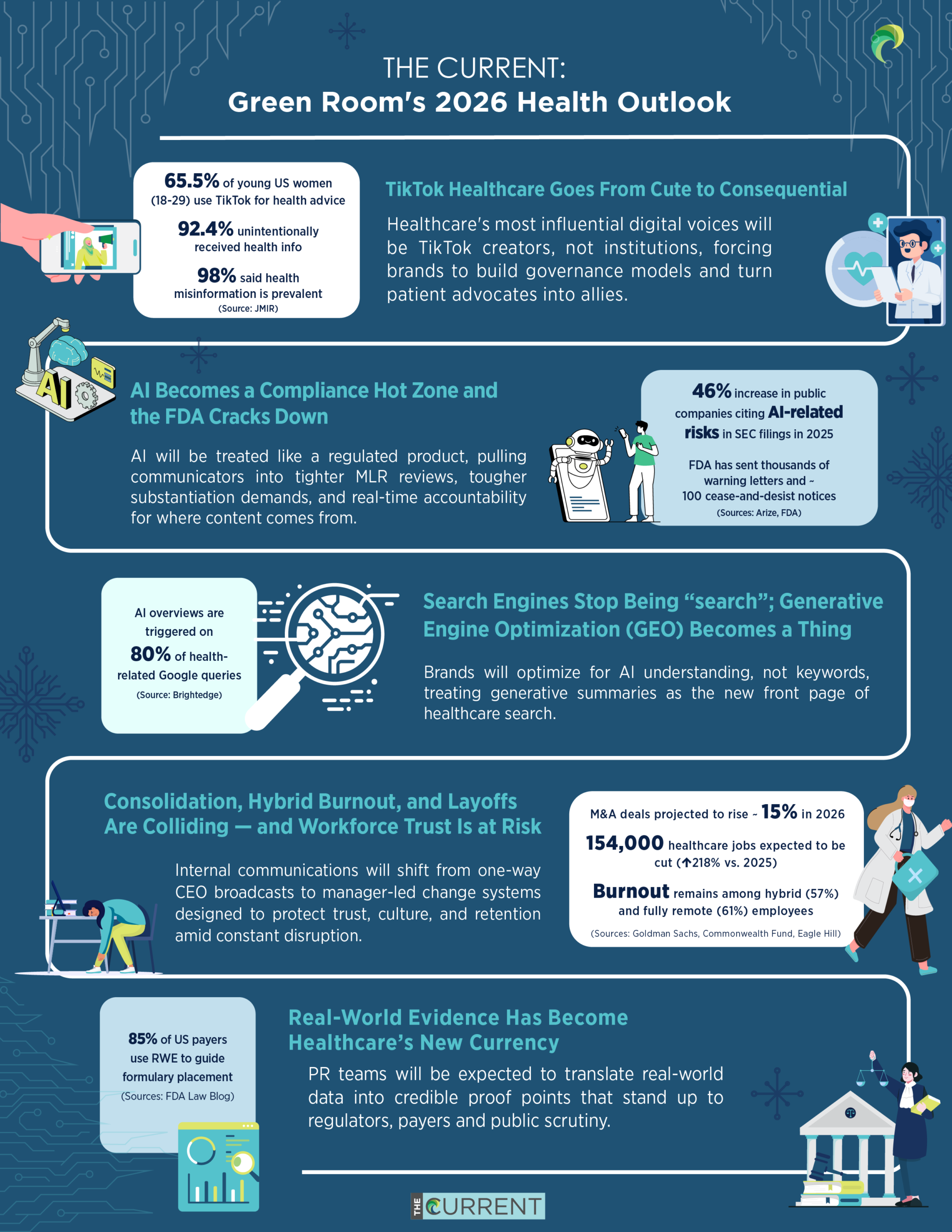
Green Room’s 2026 Health Outlook

Why LinkedIn Is The New Power Suit For The C-Suite

Seven in ten people believe CEOs, journalists, and public officials are purposely misleading them yet 80% still want business leaders to address societal issues. That’s the paradox every executive walks into the moment they hit “post.” 

LinkedIn has become the new power suit. And a suit and a C-suite profile share the same rule: they make a strong impression if tailored well. 

Technology now lets companies show rather than tell what happens behind the scenes: how products are made, who the people are, what values the company stands for. Consumers and employees expect this transparency as part of the trust equation. 

Why Executive Presence Matters
Executives face more pressure now than ever before to positively represent their companies and its values in all public areas of their lives, whether it’s their private Facebook profile or attending a Coldplay concert (read our take on that reputation rehab gambit).  

That’s why LinkedIn is critical. Four in five members drive business decisions, meaning an executive’s audience often includes decision-makers, media, and future hires.  

The Elements of a Power Profile
Every LinkedIn profile, like a good suit, needs a few things to be successful: 

  • The cut matters. A tailored suit says who you are before you speak. Likewise, a leader shouldn’t post generic company messaging. It’s got to be tailored to ensure that the leader’s voice is coming through loud and clear. 
  • The color counts. Safe choices don’t turn heads. Leaders have stories, opinions, and perspectives that add vibrancy to the feed and sharing them can make the conversation richer. 
  • Timing is everything. You wouldn’t wear a linen suit to an outdoor winter wedding. Similarly, posting should only happen when what’s being said resonates with teams, peers or the market. 

When leaders get the cut, color, and timing right, they do more than look sharp online. They reinforce trust at a moment when audiences are looking for it. 

The Wrinkle Factor
Sometimes it’s the imperfections that land best. Bristol Myers Squibb’s CEO once posted about how few of his own plans didn’t go as expected. It drew 50+ reposts, 60+ comments, and 1.7K+ engagements because audiences want leaders who are real, transparent, and resilient.  

So, who’s dressing your company?
In a world where trust in leadership is low but expectations remain high, the question isn’t whether executives should show up on LinkedIn. It’s whether they’re showing up in a suit that fits. Green Room knows a few exceptional tailors.

So You Have a Corporate Narrative—Now What?

Remember mixtapes? I remember listening to Rick Dee’s Weekly Top 40 and waiting to hit record at precisely the right moment, patching together playlists of songs of different genres with abrupt track changes. Air Supply, Motley Crue, Elton John – all on the same mixtape. 

Fortunately, today we have a new option. Carefully curated Spotify playlists allow us to select songs, each placed with a purpose, to create a soundtrack that is cohesive and intentional.  Both are stitched together, but only one can set a tone, elevate a mood, or tell a story. 

Mixtape Messaging vs. Tapestry Thinking
We see a lot of mixtape-style communications in early-stage biotech. A press release here, a data poster there and a website with just enough to say, “we exist.” Yes, these moments in time are important to communication. But why? What’s the purpose of these communications? What’s the story we are looking to tell? And as my mother once told me, you only have one chance to make a first impression. Done well, your narrative provides a bridge to all audiences: investors, partners, patients, and the media. 

Many companies fall into a seemingly productive rhythm, churning out nonstop press releases. It’s all in the name of generating buzz with investors. Cadence does matter. However, in today’s world of information overflow, if your news cycle becomes noisy, you’re not creating real value. Putting a press release over the wire and relying on syndicated pickup doesn’t allow the media – or your audiences – to have a chance to get to really know you.  Like a mixtape without a track list, fragmented messaging from early-stage biotechs can leave audiences lost until strategy ties it all together in a cohesive narrative. 

Start Talking Before the Science
As Tara pointed out in Don’t Wait for Data, telling the science story alone is just a piece of the pie; it doesn’t build credibility and reputation. This is where strategic communications play a critical role in reaching multiple audiences and making the story relevant to each one.  

A strategic narrative doesn’t pontificate about what you don’t have. It builds on what you do: your leadership’s vision, your founding story, your unique approach to addressing an unmet need. It’s not premature to speak before your trial data reads out. Without a product on the market, investors need a reason to believe, that means knowing the track records of your leadership, the skills and experience of new hires and the small steps you’re taking to build a strong foundation both internally and externally. This is the momentum the media and your other key stakeholders need to remember your name. 

How We Walk the Talk
We worked with an early-stage specialty biotech that had a competitor that appeared seemingly stronger based on media visibility. When we started working with our client, the communications were solely based on data milestones, here and there, with no cohesive story. In other words, a “mixtape” approach. Our team started digging in, looking further into the science, the unmet need, and the company leadership. Feedback from KOLs showed that our client had a scientific advantage. So why were they not seen as the leaders? The difference: they were not telling their story. They relied only on data readouts and medical congresses to tell their story, which led to disjointed storytelling and no cohesive thread pulling everything together. Journalists are not mind readers and they don’t want to do commercials for companies. In this case, the media simply were not aware of our client’s story.  

In this particular instance, we built a leadership platform that showcased the executives’ proven track records to bring clinical assets to market. We created messages that spoke to long term value, not just the next product milestone. Developing that corporate narrative that goes above brand delivers a different strategic approach, creating a backbone that allows other messages to flow from.  

The Takeaway
This isn’t about having more data. It’s a communications strategy told consistently across paid, earned, shared, and owned channels. 

It’s tempting to delay storytelling until you have more to say. And, it’s not so much refreshing your story or narrative every quarter, it’s about reinforcing your strategic core through cohesive storytelling while adapting the way you tell it. That’s what builds credibility and creates resonance. 

Because when your company’s reputation is still forming, every touchpoint matters.  

So, ask yourself: are you handing your audiences a mixtape or playing them a masterpiece?  

Let’s be honest. If your CEO gets caught on video cozied up to HR at a Coldplay concert, no one’s thinking let’s bring in Gwyneth Paltrow.” And yet, here we are. Data startup Astronomer, facing internal upheaval and a digital whisper network that’s now screaming across every corner of the internet, just named Paltrow its “temporary” spokesperson, days after placing their CEO Andy Byron on leave.

It’s certainly a move that has everyone talking. But it wasn’t strategic crisis management any more so than it was a slick pivot by Astronomer into branded content wrapped in a celebrity stunt. Because here’s the twist, Paltrow’s “takeover” was orchestrated through Ryan Reynolds’ advertising agency, Maximum Effort. Astronomer, a relatively small and lesser-known player in the data space, used this moment to go full meta marketing and in doing so, they missed a major opportunity to tell their broader leadership story.

Let’s break it down into some key crisis comms takeaways.

Don’t hide. Transparency wins.
Most companies in crisis default to silence, spin, or sudden leadership exits. Astronomer opted for none of the above. Instead, they handed the mic to an Oscar winner known for detox hacks, marital transparency, and yes, her own ties to Coldplay’s lead singer, Chris Martin. And for that, we give them credit. The board clearly said, “Don’t hide. Do something.”

Not all bold moves are strategic ones.
In Paltrow’s takeover, there was no mention of Astronomer’s core values, no clarity on leadership and no roadmap for rebuilding trust. Just vague mentions of “unifying data workflow automations” and a call-to-action to join the company at their upcoming analytics conference. She certainly helped recast the tone, but she also pulled focus away entirely.

Don’t underestimate the power of comic relief in the right setting.
When I first saw the video of Gwyneth, I immediately started my fact checking because it was so surprising I had to ensure it was actually legitimate. The distraction worked. However, the effort was not fully realized. Astronomer had the opportunity to educate the world about what it does, how it’s different and why the company should be trusted. Instead, it was just witty and only partially impactful.

It’s never a one and done.
Even with Gwyneth as the temporary company spokesperson, it’s not back to business as usual. Astronomer needs to continue to rebuild trust with customers and employees. That means thoughtful internal messaging, coordinated external leadership, and a clear stance on ethics, culture, and what’s next.

Our take?
At Green Room, we love a bold creative swing especially when companies don’t default to corporate retreat. But in this case, Astronomer missed a crucial opportunity. This could have been the start of a broader, more thoughtful narrative rebuild. While not featured in the Paltrow spot, Astronomer did announce a new CEO and a leadership transition plan—circulating quietly on LinkedIn. We’re not saying the ad needed to carry it all but tying the humor back to substance would have helped connect the dots.

Because more than borrowed star power, real crisis management demands internal reflection, structural change, and a re-anchoring of values.

Product communications aren’t one-size-fits-all. Whether you’re launching a hospital-based treatment for a rare condition or a patient activated therapy with high name recognition, understanding when and how to communicate directly with patients versus providers is critical. 

We recently sat down with Tara DiFlumeri, Head, Early Stage and Specialty Pharmaceuticals and Natalia Forsyth, Head, Digital Strategy to unpack how they approach product communications through a lens looking at products from B2B (business-to-business) vs. B2C (business-to-consumer) and where the line between the two often blurs.

1. What’s the distinction between B2B and B2C in a healthcare setting?

Tara: “B2B is typically when a pharma or biotech company is targeting healthcare providers or institutions directly, especially for complex or rare conditions, or when the drug is administered in a hospital setting. These are scenarios where specialty physicians drive decision making, and trusted, peer-to-peer education is key. In these cases, patients don’t always ask for products by name; they receive them based on clinical judgment. B2C, on the other hand, is anything designed to reach patients or caregivers directly, usually for products where consumer choice plays a larger role.” 

Natalia: “We’ve worked on several true B2B examples, like medications primarily accessed in a public health or clinic setting.  It’s about meeting HCPs or institutions, where they are not trying to drive patient demand.”

2. How does this change your strategy in practice? Are there examples of campaigns that evolved over time?

Tara: “It absolutely changes our strategy. One good example is an established product we work on used across multiple autoimmune conditions, for which we recently helped launch a self-injection device. This meant educating physicians on safety and convenience, while also preparing direct-to-patient education for people with dexterity issues due to multiple sclerosis or rheumatoid arthritis. So, we ran a parallel track of provider trust and patient empowerment, both necessary to drive adoption.” 

Natalia: “I once worked on a low libido treatment for women. We initially focused only on provider outreach, especially sexual health specialists, but faced major skepticism. When we switched to a bold, patient-first direct-to-consumer campaign encouraging women to advocate for what they deserved, it finally resonated.”

3. When do you want patients to know your product by name? How does that work in a regulated environment like healthcare?

Natalia:Consumer driven spaces like GLP-1s, contraception, migraines, or hormone therapy—you absolutely want patients walking into offices asking for the product by name. Millennials especially are now both patients and caregivers, and they expect to be part of the conversation. They’re digital natives, and the way they access healthcare is changing fast.” 

Tara: “But for some medications, particularly in acute care and hospital settings, patients might never even hear the name, let alone remember it. In those cases, all communications energy should go toward educating HCPs and institutions, not patient awareness.”

4. How do you bring digital and the patient voice into your strategy and when?

Natalia: “The gold standard is to involve patients and advocacy groups early, co-creating campaigns that feel true to lived experience. It’s not always possible, but when it is, the difference in sentiment and uptake is clear. And even later on, we use social listening and AI to surface real-world feedback often preferring organic, user generated content over polished testimonial videos.” 

Tara: “It can get tricky with consumer facing digital. Clients might want to use influencers or push the envelope creatively, but healthcare comms comes with serious regulatory considerations. We have to build review and monitoring systems that account for those risks, especially when real people are talking about real products in real time.”

5. Where do teams go wrong in mapping out B2B and B2C strategies?

Tara: “Sometimes people use ‘B2B’ to mean any healthcare provider communication, when it could also mean institution-to-institution, or pharma-to-pharma, depending on your objectives. Green Room looks at ‘B2B’ as anything that touches audiences who are not patient-facing. I find it more helpful to think in terms of your actual audiences: HCPs, advocacy groups, patients, caregivers. Not just which bucket they fall into.” 

Natalia: “And sometimes teams chase name recognition even when it doesn’t matter. If your product is hospital based or only prescribed in rare situations, patients don’t need to know the brand. The right play is to educate the right gatekeepers and stop trying to make every drug a household name.” 

The TL;DR?
Product communications in healthcare can’t be treated as plug-and-play. Every therapy has its own context, timeline, and audience whether you’re educating a specialist, informing a caregiver or empowering a patient to speak up at their next appointment. At Green Room, we start with the same question every time: Who needs to hear this first? 

Let’s face it—when the headlines are on fire, so are our inboxes, and our first instinct is to push communications externally. In uncertain times like these, healthcare communications professionals are rightfully laser-focused on ramping up external communications. There are patients to reach, shareholders to inform, and sales to protect. But in the frenzy to respond externally, there’s often a sneaky casualty that can hurt long-term success: internal communications. 

It’s easy to dismiss town halls, newsletters, email updates, and internal-facing posts as “nice to have” at best, or “adding to the noise” at worst. Yet, in today’s high-pressure, high-noise environment, these “tactics” are your strategic secret weapons for retaining and attracting the talent that remains foundational to your success. 

A Town Hall Is More Than a Microphone
At a recent client town hall, a senior leader unpacked healthcare policy changes coming down the pike that have implications for patients and the industry at large. She dedicated the time to acknowledge the external climate while connecting it to the company’s strategy and mission, and she did it in plain language, with just the right dose of transparency and optimism. The result? Employees left the meeting not just informed—but energized. They understood the factors that continue to shape the company’s next moves and, more importantly, how they can personally contribute. 

That’s business acumen in action. And in healthcare, where science, policy, and purpose collide daily, helping your people make sense of complexity isn’t optional—it’s everything. Whether that means acknowledging uncertainty, offering clarity amidst the unknown, or simply meeting them where they are. 

Newsletters = Navigation Tools
Yes, newsletters may sound “old school,” perhaps even boring. But, familiarity can bring comfort and a sense of steadiness in turbulent times. When done right, newsletters become invaluable navigation tools. Think of them as your company’s GPS through change. Highlighting regulatory updates, market trends, and leadership POVs tailored for different teams means fewer surprises for your employees. Consider a sales rep who now understands how policy changes could impact access in their territory. Or, a marketing employee grasps the why behind the new creative campaign. Your workforce stops guessing and starts aligning with organizational strategy when they are in the know. 

Turning Internal Platforms into Comms Powerhouses
When used incorrectly (or as an afterthought), popular internal platforms such as Viva Engage and SharePoint, can become digital clutter. But when used right, they’re amplifiers of a culture grounded in learning. Viva Engage posts from leaders celebrating colleagues and showcasing strategy in action, while encouraging feedback and two-way communication, help build trust, pride, and understanding around what good looks like. SharePoint pages that break down company strategy and make it easy to access on-demand resources, help employees prioritize, build business acumen, and feel empowered to learn on their own time.  

Because when the world outside is continuously evolving, what employees need most is a reminder that their company has a plan—and that they’re not just part of it, but drivers of it. 

Confidence Is an Inside Job
Here’s an undisputed fact: employees who feel informed, involved, and inspired become your most powerful ambassadors and your greatest competitive asset. They serve your patients and customers better. They make smarter and more confident decisions. They weather changes and challenges with resilience. 

When you deprioritize internal comms in tough times, it’s like trying to steer a ship without a rudder. When you invest in your employees first, you build a crew that rows in sync even when the tides get choppy. 

So yes, polish the press release and prep your media spokesperson. 

But don’t forget your team on the inside. Because the best external outcomes often start with the right internal conversation. 

Disclaimer: These images are for illustrative purposes only.

If you read through each of those and noticed a glaring error, join the Green Room crowd! In the first instance, the word “cures” is used as an unsubstantiated, absolute claim. It implies FDA approval and guaranteed results, which is prohibited if the product is still investigational and the call-to-action suggests commercial availability where there may be none.

In the second example, the press release overstates results from an exploratory Phase 2 trial and in the third, the web copy suggests efficacy and safety are proven, even though the product is still in clinical trials.

What do they all have in common?
They are non-compliant, misleading, overly promotional or unbalanced.

In our industry, proactively communicating pipeline progress and new data is essential for attracting investors, enabling scientific collaboration, laying the groundwork for approval and reinforcing corporate credibility. But companies must do so while navigating strict regulatory guidance from the FDA. Getting it wrong can result in reputational damage, investor concern or even regulatory action.

However, the FDA’s guidance on investigational product communication can be complex and open to interpretation. Missteps like overstating efficacy, omitting risks or promoting unapproved drugs can lead to public-facing enforcement like warning or untitled letters.

Coloring Within the Lines
The FDA expects that external communications about investigational or approved products ensure:

  • Accuracy: All claims must be scientifically valid and evidence-based
  • Non-misleading language: Avoid overstating benefits or minimizing risks
  • Balanced presentation: Benefits must be accompanied by risks
  • Adherence to pre-market restrictions: No promotion of unapproved drugs

Seasoned healthcare PR practitioners can mitigate risk. At Green Room, we regularly work with clients to appropriately share phase 1/2 data at major medical meetings and highlight topline results into a press release. Our team is trained to ensure the release is compliant by clearly separating exploratory findings from statistically significant endpoints and avoiding promotional language about unapproved use.

Having an agency well versed in cross-functional Medical, Legal and Regulatory (MLR) collaboration is also key here. Regulatory, legal and PR and communications teams must work together with shared commitment to transparency and consistency.

Best Practices to Ensure Compliance at Every Turn
Our Green Room team can reduce regulatory risk by:

  • Implementing robust internal review processes for all public-facing content
  • Training employees on FDA standards across functions
  • Engaging regulatory affairs early in content planning
  • Monitoring enforcement trends and adapting accordingly

Proactive, transparent communication builds trust. But to protect reputation and ensure long-term success, companies must pair transparency with compliance. That means grounding communications in both science and regulatory strategy because compelling storytelling only works when it stays within the lines.

Three hundred scientists. Four months. One global hiring campaign.

That was the ask from a top 10 pharma company facing a critical talent crunch. To deliver, Green Room scanned competitive blind spots, zeroed in on what Gen X and Millennial scientists actually care about and then crafted a bold creative platform that made it personal. We launched everywhere: on-site, online, in-feed, and hit our hiring goals with speed and precision.

Another client, a clinical-stage biotech gearing up for launch, came to us with a different challenge: build a diverse workforce that reflects its mission. We turned social into their recruiting engine. First came culture calibration. Real employees, real stories, no stock photos. Then a three-year LinkedIn campaign targeted to the people who mattered most. The result? 90% of hires sourced through social. Brand awareness was up 1,751% and zero spend was wasted on the wrong eyeballs.

This is not your old-school job posting strategy. This is social-first recruitment and it’s changing the game for biopharma. 

Recruitment as a Brand Strategy
A few years ago, recruiting in life sciences followed a predictable pattern. Post a role. Maybe splurge on a recruiter if the role was urgent.

Fast forward to today, and the paradigm has flipped. Recruitment is no longer an HR function, it’s brand strategy, reputation management and audience targeting. And it’s playing out in the feeds of scientists, PhDs, and emerging leaders who are talking shop, sharing breakthroughs, and evaluating you long before they click “apply.” 

 Let’s talk facts: 

  • 79% of job seekers use social media in their job search (CareerArc) 
  • 50% lower cost per hire for companies that invest in employer branding on social (LinkedIn) 
  • 58% of candidates vet your social presence before submitting an application (Glassdoor)

In biopharma, where the talent pool is specialized, competitive, and often passive your social channels aren’t just a nice-to-have. They’re your front door.  

Five Moves to Make Your Recruiting Strategy Actually Social-First
Here’s how we help our clients flip the script: 

  • Treat your careers page like a campaign landing page. Lead with outcomes, not org charts. 
  • Show, don’t tell. Highlight employees, not just executives. Bonus points for behind-the-scenes shots and raw testimonials. 
  • Post strategically, not sporadically. A single well-timed post can outperform ten generic ones. 
  • Engage, don’t just broadcast. If someone comments, respond. Make your brand feel human. 
  • Use paid wisely. Micro-targeted ads on LinkedIn or Instagram can surface your roles to the right candidates before they’re even job hunting. 

The Takeaway: Will They Stop on Your Post?
Biopharma companies that embrace social-first recruiting aren’t just filling roles faster, they’re building communities of curious, mission-aligned talent. In an industry where timing is everything, from clinical trials to commercialization, attracting the right people quickly and authentically can be a game-changer. 

And the best part? Many of these social tactics are more cost-effective than traditional methods, offering better reach, sharper targeting, and longer-lasting brand value. 

The talent is out there. They’re already scrolling. Will they stop on your post or someone else’s? 

Imagine planning a surprise party but forgetting to send the invites until the night before. The cake’s perfect, the decorations are up…but the room’s still empty. 

That’s the trap too many early-stage companies fall into when they delay communications until top-line data is in hand. But in today’s crowded, noisy landscape, visibility can’t wait. Stakeholders from investors and media to future partners and trial participants need to know you exist before there’s data to talk about. 

So, what do you communicate before you have results? 

You communicate your vision. Your leadership. Your promise. 

At Green Room, here’s how we guide our clients to show up early and strategically. 

Start Early. Engage Often. 

For early-stage companies, engagement isn’t just possible pre-data, it’s essential. One privately held biopharma came to us while still shaping its identity. With a subcutaneous therapy platform and clinical milestones approaching, the company needed a cohesive story. 

We helped leadership align on messaging that articulated both corporate vision and scientific potential. From there, we brought the message to life across stakeholder segments: short-term (investors, talent, media) and long-term (patients, HCPs). Each group received a tailored version of the same core story delivered in language that spoke to their individualized needs.  

Just like in corporate America, journalists are being forced to do more with less. They need time to understand the science and the unmet needs of a potential drug in a therapeutic area before reporting on it. That education takes time. Reporters need to get up to speed on your science and your story well before the data is available.  Holding up your message and media strategy creates major blind spots in accurate reporting or can even turn a journalist off from covering your news. You don’t want to leave your audience scrambling for context. 

Offer a Point of View, Not Just Updates 

Being visible isn’t enough. You need to stand for something. 

Our Green Room team worked with a pre-commercial gene therapy company operating in a rare disease space. While waiting for data, we worked with their CEO to publish op-eds, appear at investor forums and partner with advocacy leaders to elevate the disease’s unmet need and spotlight their novel approach. Afterall, without a product, audiences look for “a reason to believe.” In many cases, that means looking at the company’s leadership and their track records to build credibility on past successes. Sharing that vision as well as unique perspectives give stakeholders a glimpse into where the company could go. It provides the roadmap and sets the stage for future data milestones.  

The result? Momentum. Media interest. Trial recruitment.  

Thought leadership, when done right, builds authority and community. 

Build a Digital Presence That Scales with You 

We get it. When you are pre-revenue, web traffic may not feel like a priority. But a neglected digital presence is a liability. Whether it’s attracting top talent, supporting trial recruitment or shaping how AI interprets your brand online, a polished, findable and future-proof website is non-negotiable. 

With 80% of consumers relying on AI tools for search, your site is either fueling credibility—or fading into digital irrelevance. 

The bottom line: If you’re not telling your story, someone else will and they won’t get it right. 

Start communicating before the data drops. Establish your voice, build the foundation, and send out those invitations well before the party starts. Letting people know what to expect is always a best practice and will be sure to optimize not only your attendance at the proverbial party but getting your story in front of the right people.